From cave mouth to curtain wall
For tens of thousands of years, a window’s first job was to let a building breathe. The all-glass wall is only about 60 years old. A short history of the window, and what it can teach Ghana’s builders.
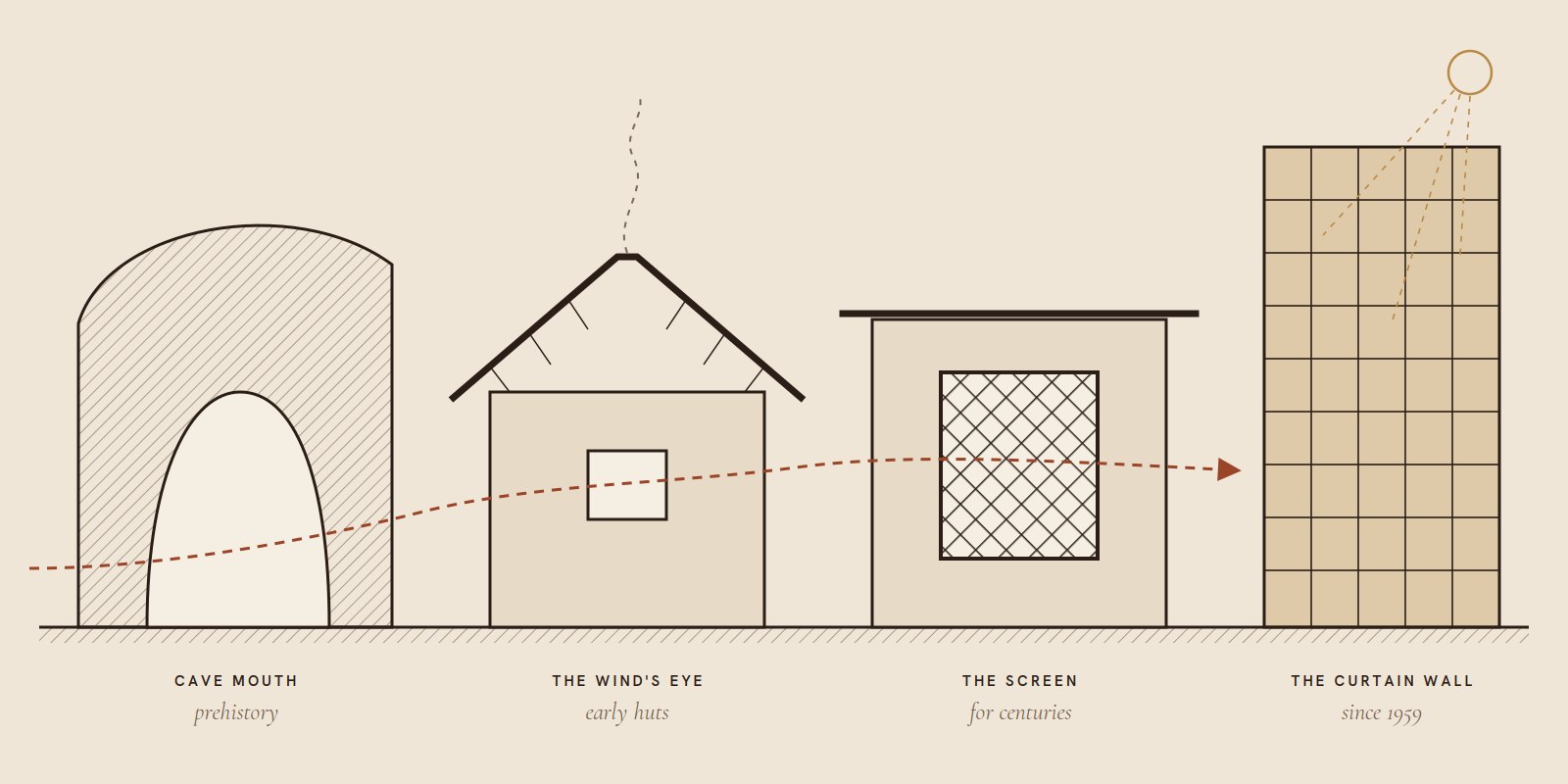
The first window was a cave mouth
Before anyone built a wall, people sheltered in caves and rock overhangs. The mouth of the cave did everything a window does today. It let in light, let out smoke and gave a view of who was coming.
It also taught the first rule of openings: size and direction matter. A cave mouth facing the wind brought in rain and cold, while one facing away kept the shelter dry but stuffy. Every window since has been an attempt to get that balance right.
This is the first of two pieces on the window. Here I step far back, to show how long it took humanity to arrive at the glass window, and how recently it became the whole wall. In the next piece, The Glass Pandemic, I will look at how Ghana made that same leap, from louvres to glass, in a single lifetime.
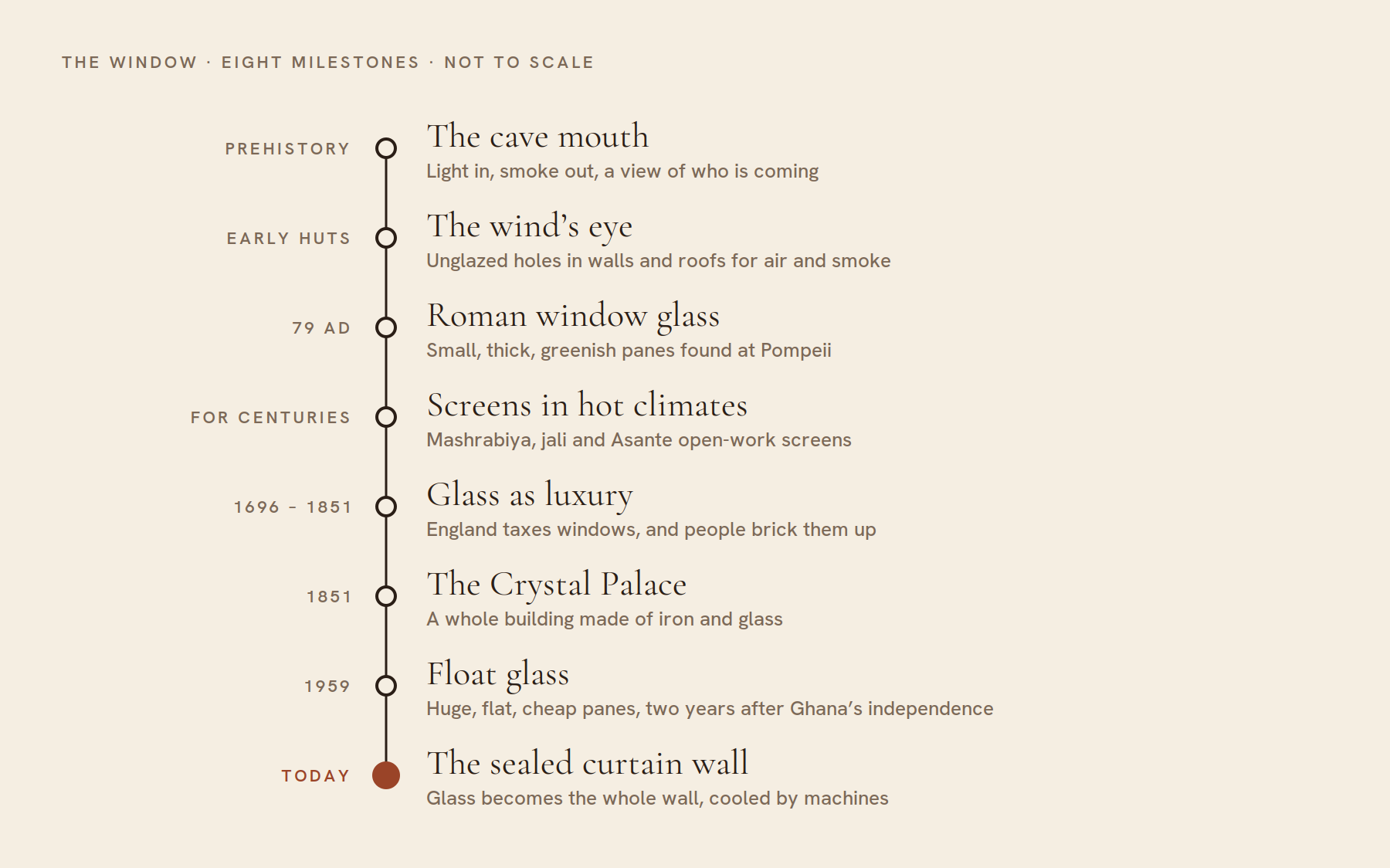
For almost all of this story the opening was for air; glass as the whole wall is the last step.
The wind's eye
When people left caves for huts of mud, timber and thatch, the opening came with them. It was a doorway, a gap under the eaves or a hole in the roof for smoke from the cooking fire.
The English word itself remembers this. "Window" comes from the Old Norse vindauga, literally "wind eye", and it first meant an unglazed hole in a roof (Etymonline). Old Frisian had an even more honest word for it, one that means "breath-door" (Etymonline).
So for most of human history, a window's main job was not to be looked through. It was to let a building breathe.
Screens before glass
In hot regions, builders did not wait for glass. They filled the opening with screens that blocked the sun but kept the air moving.
The best known is the mashrabiya of North Africa and the Middle East, a projecting window of carved wooden lattice. Its name comes from an Arabic root meaning "place of drinking", because water jars were set in it to cool in the breeze (AramcoWorld). India built the same idea in stone and called it the jali (Energies, 2021).
These were not just ornaments. A field study in a historic house in Old Jeddah found that opening its mashrabiya let in more air and cut indoor temperature by up to 2.4 °C compared with keeping it closed (Energies, 2021).
Closer to home, the Asante traditional buildings near Kumasi used open-work screens beside openings onto their courtyards (Ghana Museums and Monuments Board). Across the hot world, the window was a filter long before it was a pane.
Glass arrives, slowly
The Romans were the first to put glass in windows. The oldest window glass was found in the ruins of Pompeii and Herculaneum, buried by Vesuvius in 79 AD, and it was thick, greenish and not fully see-through (VELUX Window Collection). Even then, panes were small, and many windows used thin sheets of a translucent mineral instead (VELUX Window Collection).
For the next thousand years and more, glass stayed a luxury. Churches got stained glass, while ordinary homes made do with shutters, cloth, oiled paper or horn.
Glass was so tied to wealth that England taxed it. From 1696 to 1851, households paid a tax based on how many windows their house had, and many people simply bricked windows up to avoid paying (Wikipedia). In an 1819 debate, one member of Parliament joked that in England a window let light in, but in poor rural Ireland it was there to let smoke out (Lincoln Institute). The old job of the wind's eye had not disappeared.
Cheap glass and the glass box
The Industrial Revolution finally made glass affordable. In 1851, the same year England scrapped its window tax, London's Great Exhibition was housed in the Crystal Palace, a giant hall of iron and glass. For the first time, a whole building could be made of the material.
The real turning point came a century later. On 20 January 1959, the British firm Pilkington announced the float glass process, which pours molten glass onto a bath of molten tin to make large, perfectly flat sheets (Pilkington). Today virtually every windowpane is float glass, made in continuous ribbons that can be cut to almost any size (VELUX Window Collection).
Cheap, huge panes plus air conditioning made a new building possible: the sealed glass box, wrapped in a curtain wall. Note the timing. Float glass arrived two years after Ghana's independence, just as our own architects were designing shaded, ventilated buildings for a new nation. Within a few decades, the glass box would win.
What the long history teaches us
Lay the story end to end and one thing stands out. For tens of thousands of years, the opening's first duty was air. The all-glass wall is only about 60 years old, a blink in the life of the window.
That should give us confidence, not nostalgia. A few lessons carry straight into how we build in Ghana today:
- The wind's eye comes first. Every room needs openings that move air, before we think about views.
- Filter, don't just fill. Mashrabiya, jali, Asante screens and louvres all show that a good opening controls sun and breeze at once.
- Glass is a recent tool, not a law. It is excellent where it is shaded and placed well, and punishing where it is not.
- Fashion has always shaped windows. Romans showed off glass and Englishmen bricked windows up to dodge a tax. Our tinted curtain walls are the same kind of choice, and choices can change.
The cave mouth taught the first builders to respect the sun and the wind. We have far better materials than they did. The question is whether we will remember that first lesson.
Next on The Veranda: The Glass Pandemic, on how Ghana traded the breathing window for the sealed glass box.