Why Ghana's new homes are getting hotter
The compound houses our grandparents built stayed cool without a single air conditioner. Many of today's estates can't be lived in without one. What did we lose, and what can we take back?

Walk into an old compound house in Kumasi or Cape Coast at two in the afternoon and the first thing you notice is the air. It moves. The thick walls are still holding some of the morning's coolness. The courtyard draws warm air up and out of the house. The deep veranda keeps the sun off the walls and out of the rooms. Nobody modelled any of this on a computer. It came from generations of people building for the climate they actually lived in.
Now visit a new estate on the edge of Accra. The rooms are smaller and the ceilings lower. The windows are tight, and each one sits behind a welded burglar-proof grille. The roof is a sheet of metal with very little between it and the bedroom below. By mid-afternoon the inside of the house is hotter than the street outside, and the air conditioner stops being a luxury. It becomes the only way to live in the house.
I have spent a lot of time on sites, and the pattern is easy to see once you look for it. We didn't forget how to build cool houses. We stopped asking our houses to do the work.
What the numbers say
This isn't only a feeling. In 2021, a team of researchers led by Robert Wilby placed temperature loggers inside homes in low-income communities in Accra and Tamale. Over the same period, the weather station in Accra recorded a highest temperature of 37.0°C. Inside some of the homes, loggers recorded up to 45.9°C.
The same study found that the roof was one of the biggest factors. Most of the Accra homes had metal or asbestos roofs, and adding a ceiling with insulation lowered the hottest daytime temperatures inside the same houses by close to 7°C. Two-storey homes also ran cooler during the day than single-storey ones.
There was a catch, and it matters. Some of the measures that cooled houses during the day made them warmer at night, because the heat stored in the building had nowhere to go. A house that only blocks heat, without letting it escape, simply moves the problem from the afternoon to bedtime.
We didn't forget how to build cool houses. We stopped asking our houses to do the work.
What the old houses did right
The traditional compound house solved both halves of that problem: keep the sun out by day, and let the heat leave at night.
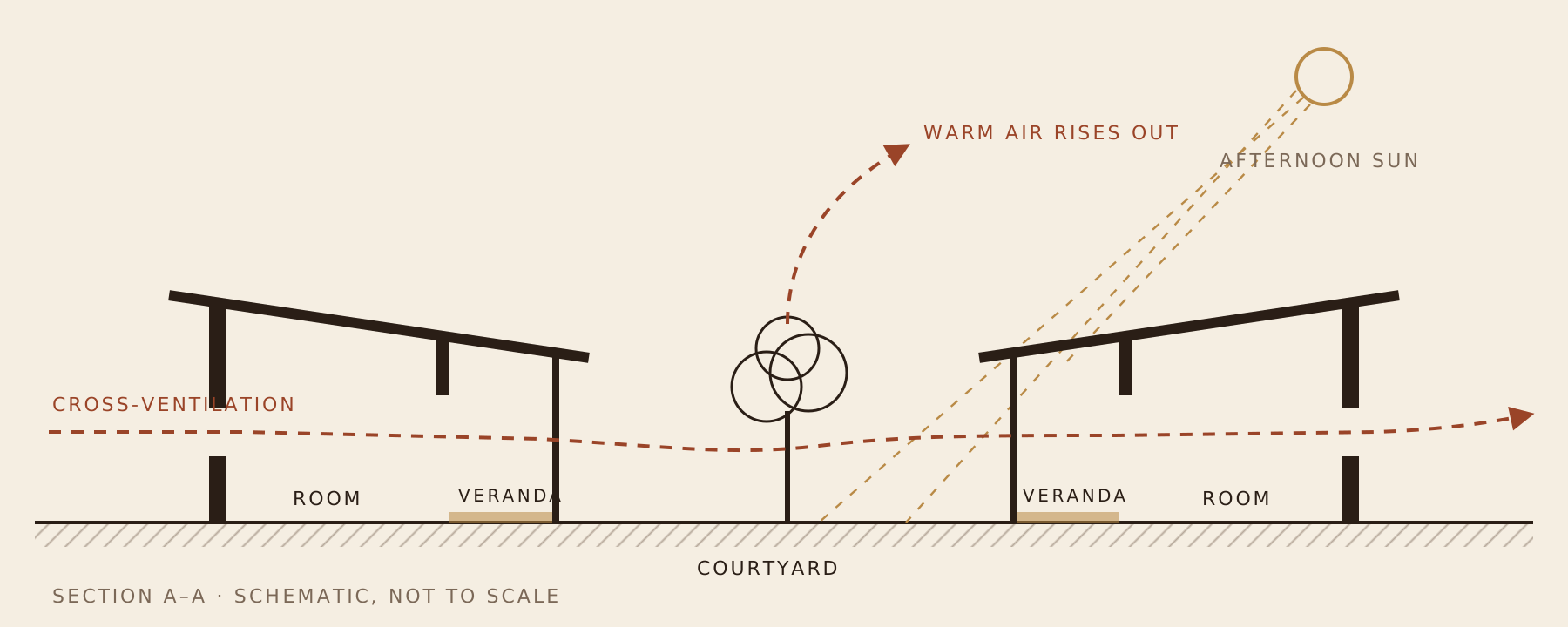
Shade before the sun reaches the wall. Deep roof overhangs and verandas meant that for most of the day, direct sunlight never touched the walls of the rooms. A wall that stays in shade doesn't need to fight the heat at all.
Air that can pass through. Rooms opened onto the courtyard on one side and often had openings on the other. Even a light breeze could cross the room. Breeze blocks and louvres let air in while still giving privacy and some security.
Somewhere for hot air to go. Warm air rises. Higher ceilings, roof vents and the open courtyard gave it a way out, and that same movement pulled cooler air in at ground level. At night, this is what let the house shed the day's heat.
Materials that suit the climate. Thick earth and laterite walls absorb heat slowly. Combined with shade and night-time airflow, they keep the indoor temperature steadier than thin walls do.
Why we moved away from it
None of this is about nostalgia. The modern house in Ghana looks the way it does for real reasons.
Land in our cities is expensive, so plots are smaller and houses are pushed to the boundary walls, which leaves little room for courtyards or deep verandas. Sandcrete blocks and metal roofing sheets are available everywhere, every mason knows how to use them, and they go up quickly. Security is a real concern, so windows get smaller and grilles get heavier. And for many families, a house that looks modern, with glass, tiles and a flat parapet, says something about how far they have come.
The problem is that we kept the materials and the look, and dropped the climate thinking that used to come with building. Then we bought air conditioners to make up the difference, and we pay for it every month in electricity bills.
Five changes any new house can make
The good news is that most of these fixes cost little or nothing if they are decided early, at drawing stage, before the first block is laid.
1. Treat the roof as the main heat shield. Put a ceiling under every metal roof, add insulation above it, and leave ventilation in the roof space so trapped heat can escape. Light-coloured roofing reflects more of the sun as well.
2. Shade the walls, especially east and west. Extend roof overhangs and add a veranda or covered walkway on the sunniest sides. Low morning and afternoon sun from the east and west is the hardest to block, so keep large windows off the west wall where you can.
3. Design every room for cross-ventilation. Place windows on opposite or adjacent walls so air has a path through the room. Use louvres, breeze blocks or well-designed security screens rather than sealing every opening into a small box.
4. Give hot air a way out. Raise ceiling heights where the budget allows, and add high-level vents or clerestory openings. This is what lets a house cool down at night instead of holding the day's heat until morning.
5. Look again at local materials. Researchers at KNUST and the University of Nottingham found that adding treated palm fibre to sandcrete cut its thermal conductivity by 38%. Laterite, compressed earth blocks and stabilised soil are worth a serious second look for the same reason. I will come back to materials in a future essay.
A house that breathes
Air conditioning has its place, and in a hot city it isn't going away. But it should be the last layer of comfort, not the only one. A house that is shaded, ventilated and roofed properly needs less of it, costs less to run and stays liveable when the power goes off.
Our grandparents' houses weren't perfect. They were, though, designed for the place they stood. That is the lesson worth keeping: build for the sun we have, the breeze we have and the way we actually live. The rest is detail.
In the next essay, I'll look at laterite, earth blocks and the other local materials we keep overlooking. If you build, design or simply live in Ghana's heat, I would like to hear what has worked for you.
Sources
- Wilby, R. L. et al. (2021). Monitoring and moderating extreme indoor temperatures in low-income urban communities. Environmental Research Letters, 16, 024033.
- Opoku, R., Obeng, G. Y., Darkwa, J. and Kwofie, S. (2020). Minimizing heat transmission loads and improving energy efficiency of building envelopes in sub-Saharan Africa using bio-based composite materials. Scientific African, 8.